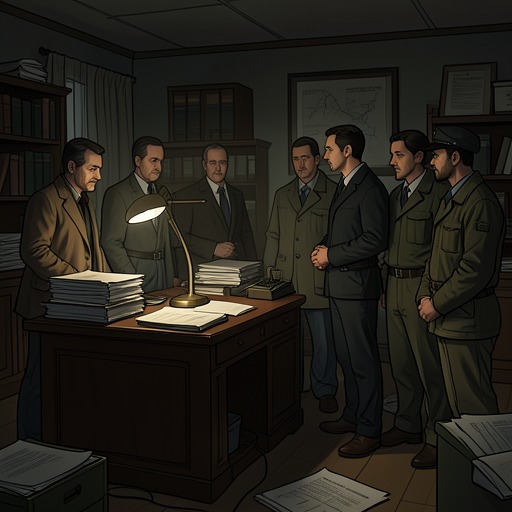
Erik LaGrange
Day of the DeadErik LaGrange is a University of Arizona fundraiser whose long affair with Gayle Stryker draws him into the orbit of a murder investigation and leaves him isolated, professionally compromised, and ultimately dead in jail. The novel gives his story a quiet, reflective opening: on a Saturday morning, after a sleepless night, he sits with coffee and tries to imagine beginning again. That possibility narrows as the past he has neglected catches up with him, and as other people turn his relationship with Gayle into an explanation for a crime he says he did not commit.
Identity and Background
At thirty-five, Erik has no wife or children, a fact he initially treats as freedom to start over. His work has been in nonprofit development, including five years at Medicos for Mexico, where he held a comfortable fundraising job. Yet a career in that field depends on reputation and references; he knows that the loss of his position, combined with the damage to his standing, will make finding another job difficult. His private choices have therefore become practical liabilities, not merely regrets.
Erik’s memories of his grandmother, Gladys Johnson, supply one of the few dependable sources of affection in his account of himself. She had scolded him while he was growing up, but he understood those reprimands as expressions of love and misses her cheerful outlook as well as her sharp tongue. Her remembered stories about Isle Royale sharpen his awareness of the difference between escape imagined from afar and a place one has actually left. When the noise of Tucson, Arizona, interrupts his thoughts, the memory helps him decide that he needs to get away long enough to think clearly.
The Affair and the Turning Point
Erik met Gayle at the University of Arizona Alumni Association’s President’s Ball. He was a junior-grade university fundraiser keeping a low profile among wealthy graduates; she arrived as the conspicuous, confident chief financial officer of Medicos for Mexico. Gayle approached him, asked who he was, and invited him to consider leaving university fundraising to work for her. Her attention flattered and dazzled him. He took her card, and the encounter became the beginning of a relationship that lasted more than five years.
The imbalance in that relationship was present from the start. Gayle was married to Lawrence Stryker, and Erik asked more than once whether she might leave him. Gayle joked that she considered it frequently, but she did not discuss divorce or make any change to the arrangement. The affair remained largely private: because Gayle’s social standing made public outings difficult, the two spent their time at home, ordered takeout, and later went back to their separate homes. Erik’s recollection of the pattern makes clear how thoroughly his life became organized around Gayle while the rest of his friendships receded.
A birth announcement from Ryan and Brianna Doyle brings that cost into focus. Erik and Ryan had been friends since fifth grade, and Erik had been best man at Ryan’s wedding, yet he had scarcely seen Ryan and Brianna since Gayle entered his life. The announcement of their son, Kyle, forces Erik to compare their new family life with the narrow routine he has accepted. He is surprised that his old friends still include him in their Christmas cards and announcements; the baby’s photograph makes him confront how much of his own life has been displaced. That recognition joins his looming job loss and damaged reputation as part of the crisis he tries to think through on the mountain.
Flight, Reflection, and Arrest
Erik’s immediate response to that crisis is to walk. He packs sunscreen, water, sandwiches, cheese, and dried apricots, then sets out from the Catalina foothills home he is minding for Professor Raymond Rice and Frieda Rice. Rather than drive the short distance to the Finger Rock Trail trailhead, he decides to walk there from the house. The choice gives his effort to clear his mind a literal form: he tries to leave the pressures of the city behind by putting one step after another between himself and home.
The hike does not resolve his predicament. On the descent, an injured ankle makes each step painful, and he has used up his water. He plans to call for a ride once he reaches the trailhead, but rules out calling Gayle after their previous night together. That physical difficulty coincides with the emotional conclusion taking shape in his thoughts: leaving Tucson may be the only way to escape a past that Gayle could otherwise destroy for him. His sense of having a choice, however, is overtaken by the investigation.
Detective Brian Fellows of the Pima County Sheriff’s Department approaches Erik at his house. A teenage girl’s dismembered body has been found near Vail, and Erik’s business card is among the items believed to belong to her. When Brian presents a search warrant, Erik is bewildered that the investigators connect him to the victim; he says he has not been near Vail in years and cannot explain how she came to possess the card. He is arrested and later charged with first-degree murder. The card becomes a small object with enormous force: it places him inside a case whose central facts he says he does not know.
Imprisonment and Death
At his first meeting with Brian in jail, Erik acknowledges that refusing to speak without a lawyer may have been poor judgment, but insists that the case is a mistake. He says he did not know the victim or what happened to her, denies involvement, and offers to help find whoever was responsible. His willingness to cooperate contrasts with the investigators’ suspicion and with his growing conviction, during sleepless nights in custody, that no one will come to his rescue. He believes that the people pursuing him have accepted his guilt, even though he maintains his innocence.
The public account of the case further closes around him. Gayle learns from television that Erik has been charged and has attempted suicide in his jail cell. She treats the report as an opportunity: if he dies, she believes the attempt itself will reinforce assumptions of guilt; if he lives, she plans to present his impending job review as a motive for murder. The review, which she had earlier described to a reporter, becomes a story she can use against him. The contrast is stark: Erik’s professional vulnerability is real, but Gayle turns it into a public explanation for a killing that he denies committing.
Erik is later found hanging in his Pima County Jail cell. A news report says he has died from injuries described by the medical examiner’s office as self-inflicted. Lawrence Stryker hears the report and understands that Gayle has finished with Erik; the news also leaves him wondering whether she might one day finish with him. Erik’s death thus resolves his immediate fate but does not end the danger surrounding the people who remain. The novel gives no recovery or vindication for him in these scenes; his innocence remains his own repeated claim while Gayle’s manipulation and Lawrence’s fear expose the larger machinery around the case.
Narrative Role and Significance
Erik’s recollections connect an intimate failure of judgment to a public accusation. His affair with Gayle is not presented as a simple romance: it pulls him away from Ryan and Brianna, compromises his work, and leaves him dependent on someone who refuses to change the terms of their relationship. When that arrangement collapses, he has neither an intact professional reputation nor a strong circle of friends immediately around him. His remembered grandmother offers a counterpoint—a loving voice that can criticize him without abandoning him—but memory cannot intervene in the investigation.
The novel also places Erik’s assertion of innocence beside the ease with which a plausible story can be manufactured about him. A business card links him to the unidentified victim; a looming job review can be recast as motive; and his suicide attempt can be used to strengthen public suspicion. These details do not establish what happened to the girl, but they show how Erik becomes legible to others through fragments that Gayle can exploit. His trajectory from a man trying to hear himself think to a prisoner whose death is reported as confirmation of guilt gives the case its human cost: he is not only accused, but stripped of the chance to make his own account prevail.